
As advertisers look ahead, one thing is clear: the old playbooks aren’t working the way they used to.
Media fragmentation, rising pressure to prove ROI in the age of AI, and an explosion of creative formats have changed how brands compete for attention—and how success is measured. It’s no longer just about where you spend, but how quickly you adapt to what’s actually resonating in the market.
In our recent State of the Industry: 2026 Advertising Predictions webinar, we broke down the biggest advertising trends we predict will shape 2026—using real market signals, creative intelligence, and competitive insights to show how advertiser priorities are evolving.
The K-Shaped Economy Is Reshaping Advertising Strategy
One of the most important macro forces influencing advertising decisions heading into 2026 is the continued reality of a K-shaped economy.
Rather than a uniform recovery or slowdown, different industries, brands, and consumer segments are moving in very different directions. Some categories are seeing sustained growth and increased investment, while others remain under pressure—forcing advertisers to make more deliberate, uneven bets.
.png?width=601&height=337&name=Advertising%20in%20K-Shaped%20Economy%20(3).png)
Image from MediaRadar’s State of the Industry: 2026 Advertising Predictions webinar Source: S&P 500 vs University of Michigan Consumer Sentiment Survey.
For marketers, the disparity between high to low and middle-incomes has real implications:
- Budget growth is no longer evenly distributed across categories
- Performance expectations vary widely depending on audience and price sensitivity
- “One-size-fits-all” strategies are increasingly ineffective
In this environment, knowing where growth is happening matters just as much as knowing how much is being spent. Even more so, knowing what end of the K is the best place for a brand to play and win puts even more pressure on advertisers to make intelligent decisions.
Advertisers that are outperforming today tend to be those that understand their position within this K-shaped landscape—adjusting messaging, creative, and channel mix based on how their specific audience is experiencing economic pressure or resilience.
AI’s Share of Search Ad Spend Is Surging
Search advertising is entering a new phase—one increasingly shaped by AI-driven experiences.
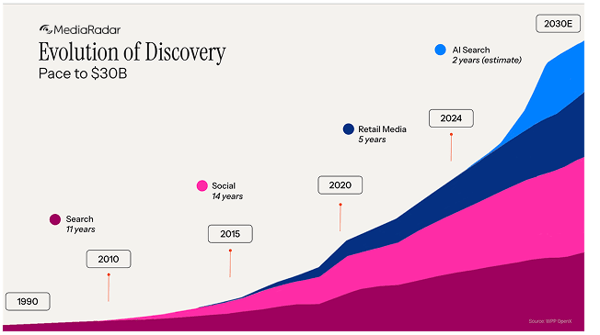
Image from MediaRadar’s State of the Industry: 2026 Advertising Predictions webinar
As AI-powered search tools and assistants gain traction, advertiser attention (and budget) is beginning to follow. Rather than replacing traditional search outright, these experiences are changing how and where consumers discover information, evaluate options, and make decisions—creating new dynamics for brands that have long relied on search as a performance mainstay.
What’s shifting:
- Discovery is becoming more conversational and less keyword-dependent
- Fewer touch-points can now influence more of the decision journey
- Visibility is increasingly shaped by context, relevance, and intent—not just bids
For advertisers, this raises important strategic questions. As AI-driven search environments evolve, understanding where audiences are spending time—and how brand presence shows up in those moments—becomes critical to maintaining visibility and performance.
At the same time, this shift adds another layer of complexity to search investment decisions, particularly as budgets are rebalanced across channels and formats that influence demand earlier in the funnel.
Open Web Display Advertising Will Be Squeezed
Open web display advertising is facing increasing pressure as advertisers rethink how and where they allocate budgets. Between ongoing signal loss, heightened performance scrutiny, and growing competition from closed ecosystems, the open web is being asked to do more with less. For many brands, this has led to tougher questions around effectiveness, measurement, and differentiation—especially as alternative channels promise clearer outcomes or tighter targeting.
Several forces are converging at once:
- Increased investment in walled gardens and commerce-driven media
- Higher expectations for performance and accountability
- Greater emphasis on formats and environments that influence intent earlier in the funnel
As a result, open web display is no longer competing on scale alone. Its value is increasingly tied to context, quality, and strategic alignment within a broader media mix.
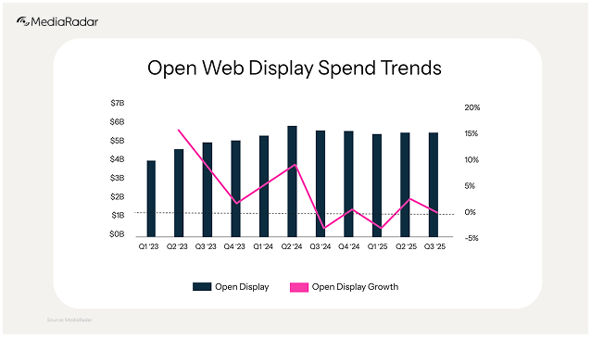
Image from MediaRadar’s State of the Industry: 2026 Advertising Predictions webinar
Advertisers that continue to invest in the open web are becoming more selective—prioritizing placements, creative approaches, and partners that align with specific objectives rather than treating display as a default line item.
TV Advertising Is Moving From Broadcast to Narrowcast
TV advertising is undergoing a structural shift—from broad, one-to-many reach to more targeted, audience-driven delivery.
As streaming, connected TV, and data-enabled buying continue to mature, the traditional broadcast model is giving way to a more narrowcast approach, aka the Video Everywhere Challenge. Advertisers are no longer just buying audiences at scale; they’re increasingly focused on which audiences they’re reaching, when, and in what context..png?width=603&height=345&name=Open%20Web%20Display%20Advertising%20Will%20Be%20Squeezed%20(3).png)
Image from MediaRadar’s State of the Industry: 2026 Advertising Predictions webinar
The narrowcast evolution is reshaping how TV is planned and evaluated:
- Reach is being balanced with precision and relevance
- Linear and streaming strategies are converging rather than competing
- Measurement expectations are rising as TV is held to performance standards once reserved for digital
For brands, this means TV is no longer a siloed, top-funnel channel. Instead, it’s becoming a more flexible part of the broader media mix—capable of supporting both awareness and performance goals when used strategically.
At the same time, this shift introduces new complexity, from fragmented inventory to inconsistent measurement across platforms, making visibility and clarity more important than ever.
Live Sports Is Driving the Next Wave of New Ad Formats
Live sports continue to be one of the most powerful—and resilient—environments in advertising. As viewing shifts across linear, streaming, and hybrid platforms, live sports is increasingly becoming a testing ground for new ad formats and experiences.
Unlike many other types of content, live sports commands real-time attention at scale, making it uniquely suited for innovation. Advertisers and media owners are using these moments to experiment with formats that feel more integrated, interactive, and contextually relevant—without disrupting the viewing experience.
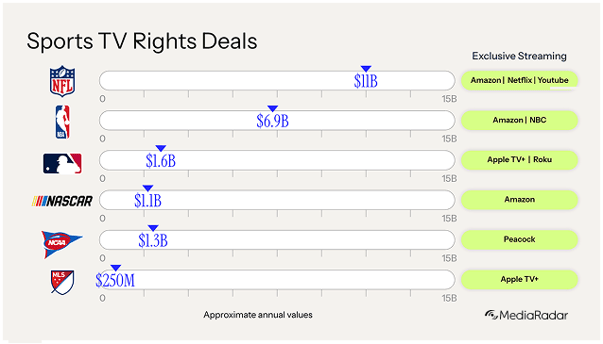
Image from MediaRadar’s State of the Industry: Navigating the Seismic Shift In Sports Advertising webinar
Several dynamics are accelerating this shift:
- Audiences are consuming live sports across a wider mix of platforms and devices
- Advertisers are seeking deeper engagement beyond traditional :30 spots
- Rights holders and platforms are motivated to unlock new revenue opportunities
As a result, live sports is playing an outsized role in shaping how advertising evolves across premium video—often influencing formats that later expand into other types of content. With major global events like Super Bowl LX and the Winter Olympics, it’s never been more important to capture a full market view—so you can spot the signals that drive the strongest sports advertising insights.
Success Starts With Understanding What’s Working Now
The biggest mistake advertisers can make heading into 2026? Planning in a vacuum.
The brands best positioned for this year aren’t just forecasting—they’re:
- Studying live market activity
- Tracking shifts in creative volume and messaging
- Learning from both category leaders and unexpected disruptors
Success in 2026 will belong to teams that treat market intelligence as an always-on input—not a one-time report.
If you’re a brand marketer planning your 2026 budget, a growth or performance team under pressure to prove ROI, or an agency advising clients in fast-moving, competitive categories, the State of the Industry: 2026 Advertising Predictions webinar offers a deeper look at these trends—along with a downloadable slide deck you can share with your teams.
Our next State of the Industry webinar is March 19: Video Everywhere—Winning in the New Era of CTV. Register today.
.jpg?)

.jpeg?)