
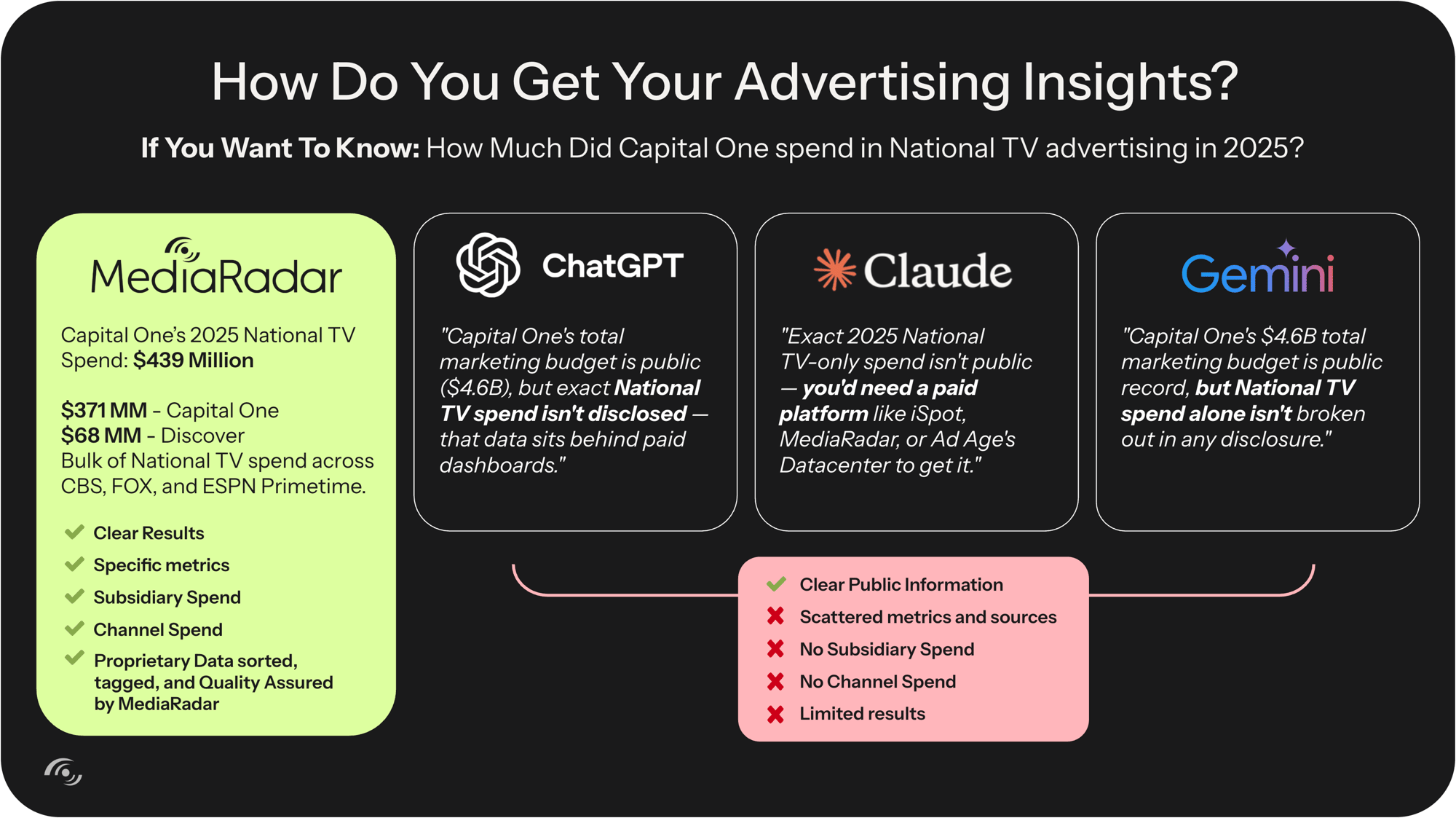
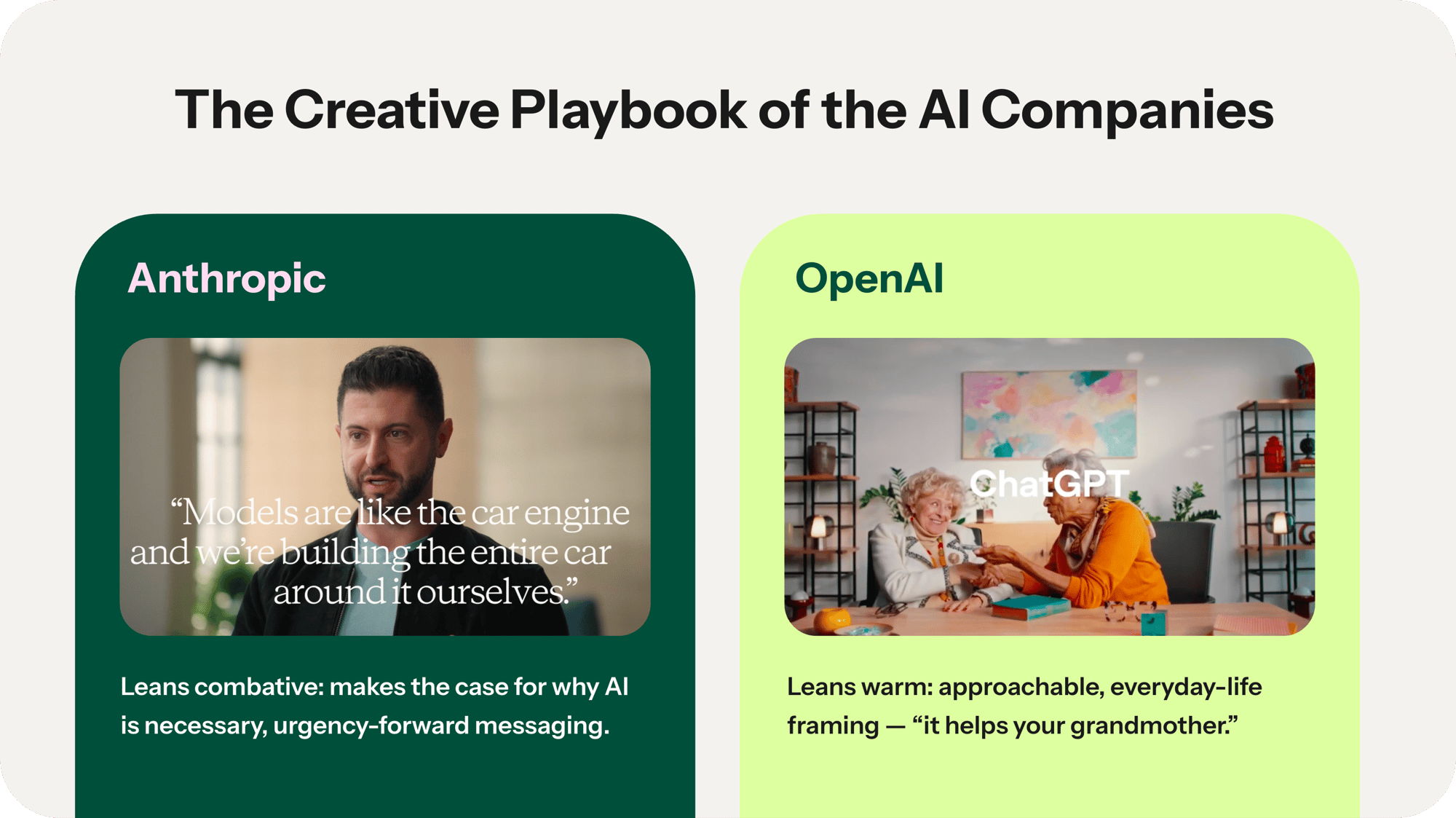
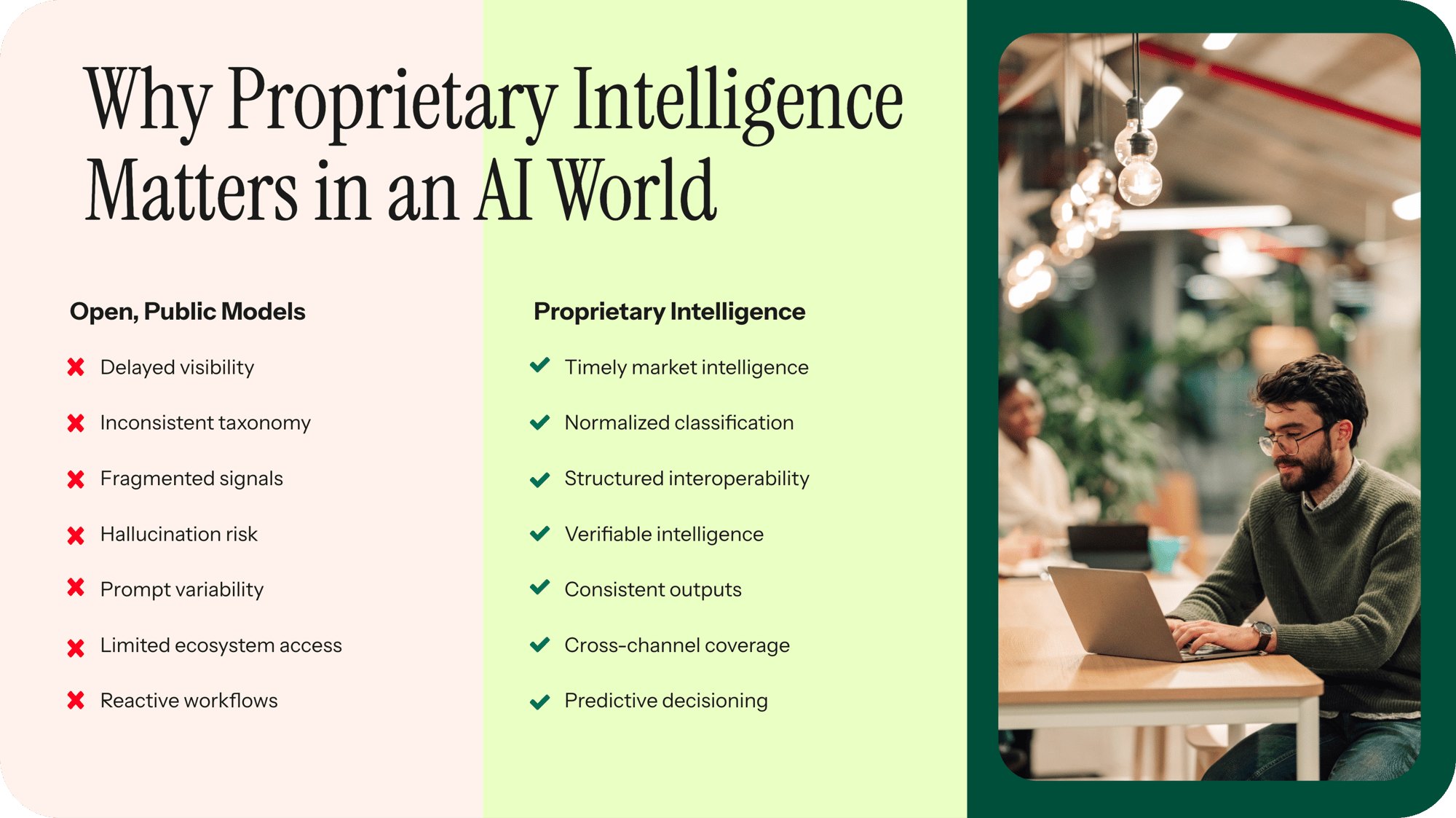
AI is changing how the industry works, but the hype is outpacing the truth. Public models are fast, but they bias toward the loudest ads, miss real-time shifts, and can't be trusted with your biggest investment decisions. In this State of the Industry session, MediaRadar CEO Matt Krepsik and Chief AI Officer Eric Kallemeyn cut through the noise: how marketers are actually putting AI to work today, why clean, normalized data is the foundation that makes AI reliable, and how you stack up against your peers based on our latest industry benchmark. Then we turn the lens on the AI companies themselves — previewing our upcoming Future Titans report and breaking down how the biggest players are positioning through their own advertising. Walk away knowing where AI in our industry really stands, and how to build on intelligence you can trust.
ON-DEMAND WEBINAR
Ai in Advertising
HOSTED BY
Karisa Schroeder
Director, Product Marketing
As Director of Product Marketing at MediaRadar, Karisa leads our go-to-market strategies to launch and scale new innovations with expertise in marketing intelligence, creative strategy, sports, and AI-enabled data and insights.
PRESENTED BY
Matt Krepsik
CEO
Experienced media executive with a demonstrated history of working across the media and information technology industries. Skilled in big data, artificial intelligence, technology, marketing, and market research.
PRESENTED BY
Eric Kallemeyn
Chief AI Officer
Eric brings nearly two decades of experience scaling engineering teams across ad tech, with deep expertise in machine learning and data infrastructure.


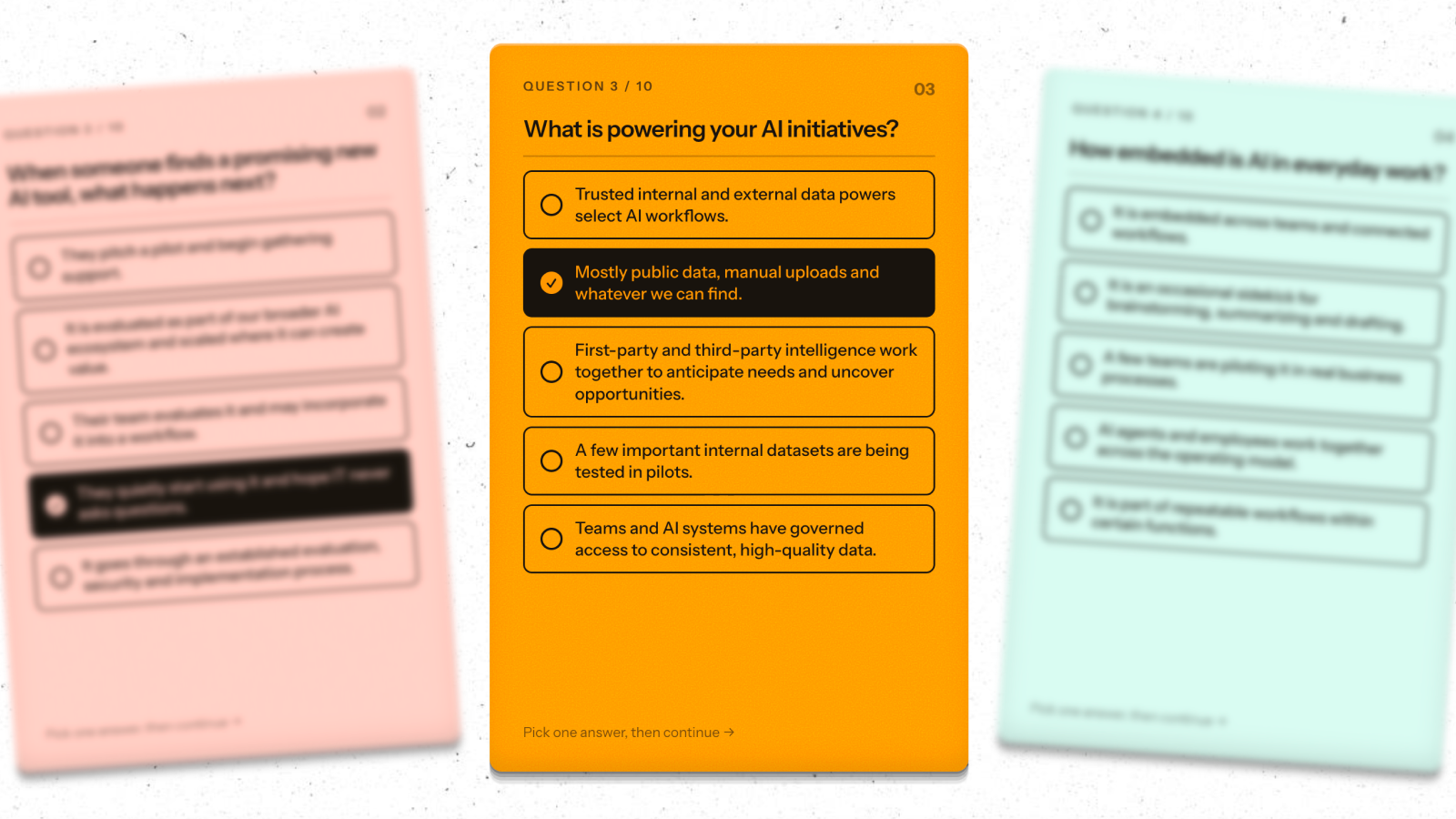
AI Readiness Quiz
What's Your AI Era
Webinar Q&A
What do we believe the consumer experience will look like if brands get caught in a continuous reactionary war, constantly responding to one another? Do we believe this will help brands grow?
That's definitely the risk of "reactive workflows." Speed without direction just means you're moving fast in a circle.
The differentiator isn't reacting faster than the next brand, it's reacting on better information. 47.1 million US adults are already using generative AI for personalized recommendations, and 64% of marketers admit they never even check how their brand shows up in those AI answers. So the actual competitive risk isn't "who reacts quickest"—it's "who's still invisible while everyone else is optimizing."
This is where proprietary data becomes the real advantage. Anyone can automate a reaction. What you can't automate is a voice no one else can replicate—and that voice has to be built on intelligence that's actually yours, not the same signals your competitors are watching. That's the value MediaRadar brings: it gives you the proprietary intelligence to build an authentic point of view instead of an echo of what everyone else is already doing.
Brands that win here treat agentic AI the way we talked about internally: guardrails and context first, reaction second. Use agents to stay responsive on the operational stuff (bid adjustments, creative rotation, budget pacing) so your team's time goes toward the parts AI can't do—taste, craft, and the actual story you're telling. The brands that turn this into a pure reaction loop will burn budget and erode trust. The ones that pair automation with a clear point of view will be the ones consumers actually notice.
How do you imagine the media measurement workflow will change in the world of AI search? And how do you validate that your outcomes were linked to those AI search results?
The new workflow needs a visibility layer before an attribution layer: are you even showing up in the AI-generated answer, how often, and in what context (recommended, mentioned, or absent entirely)? That's the gap the AI Visibility Index and Readiness Assessment EMARKETER's building are meant to close—and it's notable that 64% of marketers currently never check this at all.
On validation specifically, direct last-click attribution to a single AI answer isn't reliable yet, and probably won't be for a while given how variable and unverifiable model outputs still are. The more defensible approach right now is correlational: track branded search lift, direct traffic, and conversion rate in the weeks after you increase presence/mentions in AI answers, the same way brand lift studies worked pre-digital. Pair that with controlled testing—running the same prompts over time to see if your brand's presence in AI answers moves with campaign activity—rather than expecting a clean, trackable path from AI answer to purchase.
Isn't a large part of the trust factor here that AI is currently perceived as agnostic and objective? Consumers believe it has a world of information at its fingertips and its recommendations reflect that. As AI search becomes more monetized with advertisers paying to be part of those recommendations, won't consumers lose that trust once they realize it's essentially just a paid ad?
A few things point to how this plays out:
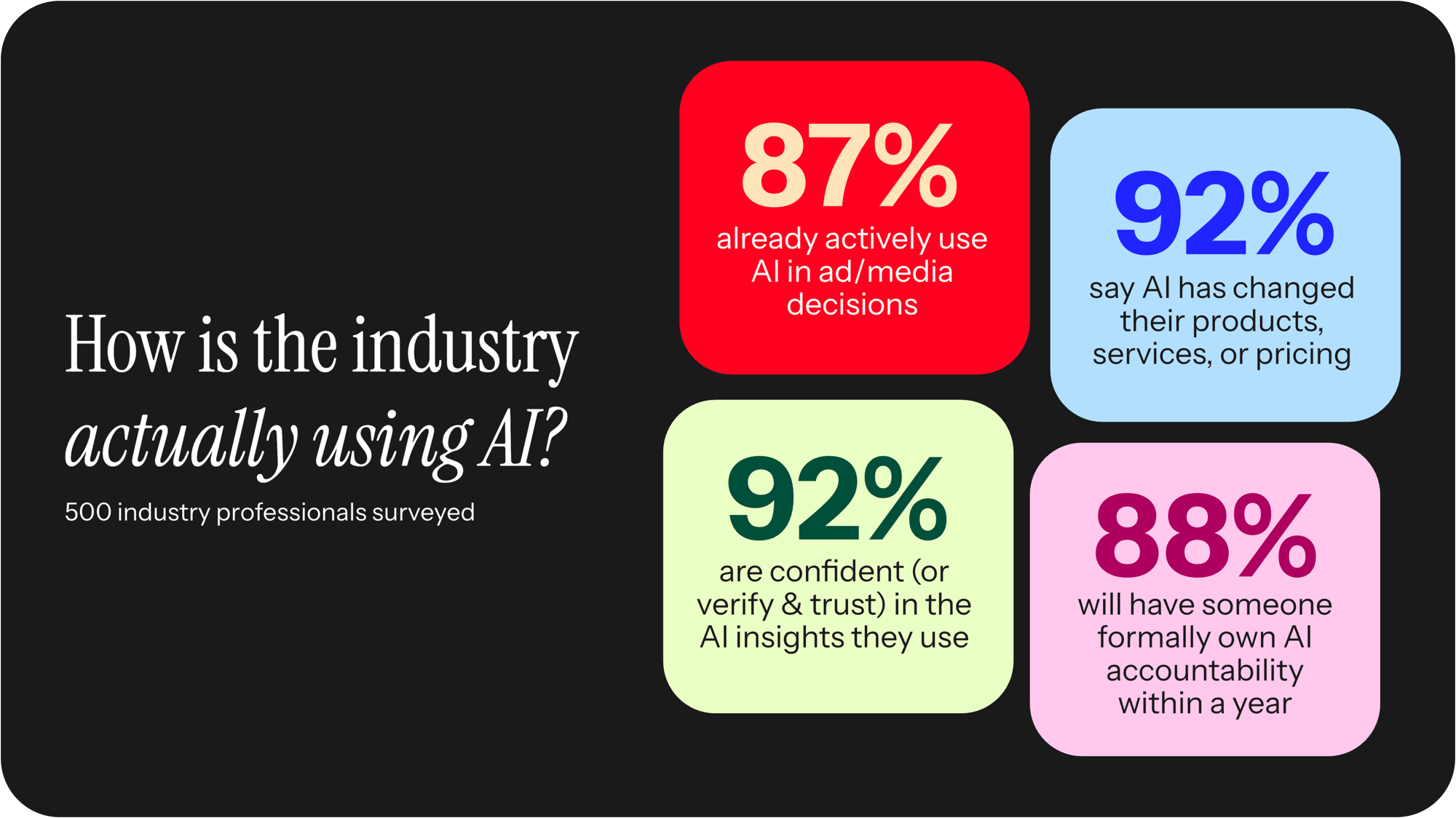
- The trust is already softer than it looks. 92% of the industry says they're confident in AI insights, but the biggest stated concerns are hallucination, unverifiable sourcing, and inconsistent outputs—not monetization. A lot of that comes down to LLMs pulling from open, community-sourced data that hasn't been vetted, so the model is often as reliable as its weakest input. Consumers are primed to question AI accuracy already; paid influence is just one more reason, not a new category of doubt.
- 64% of AI recommendation users say they'd consider switching brands based on what AI recommends—that's a lot of behavioral trust already in motion, and it took hold before heavy monetization existed. That trust won't vanish overnight once ads enter the picture; it'll erode gradually, the way search trust did, not collapse all at once.
- The real risk isn't "wising up"—it's disclosure. Consumers generally tolerate paid influence when it's labeled (sponsored posts, affiliate links). What kills trust fast is when it's not disclosed and gets discovered—that's a brand-safety and platform-safety issue as much as a marketing one.
Where this lands for advertisers: the brands that win won't be the ones gaming their way into AI recommendations quietly—they'll be the ones with a legitimate, verifiable claim to being recommended, because platforms and regulators are both moving toward disclosure requirements, and consumers will reward (or at least tolerate) transparency over stealth. This is exactly why we keep coming back to proprietary, verifiable data as the foundation—in a world where AI-driven recommendations are increasingly monetized, being able to prove why you're being recommended becomes a trust asset, not just a media buy.
Do LLMs read advertorials and influencer videos? And what's the best way for brands to meaningfully influence LLMs so they get recommendations that actually encourage users to switch?
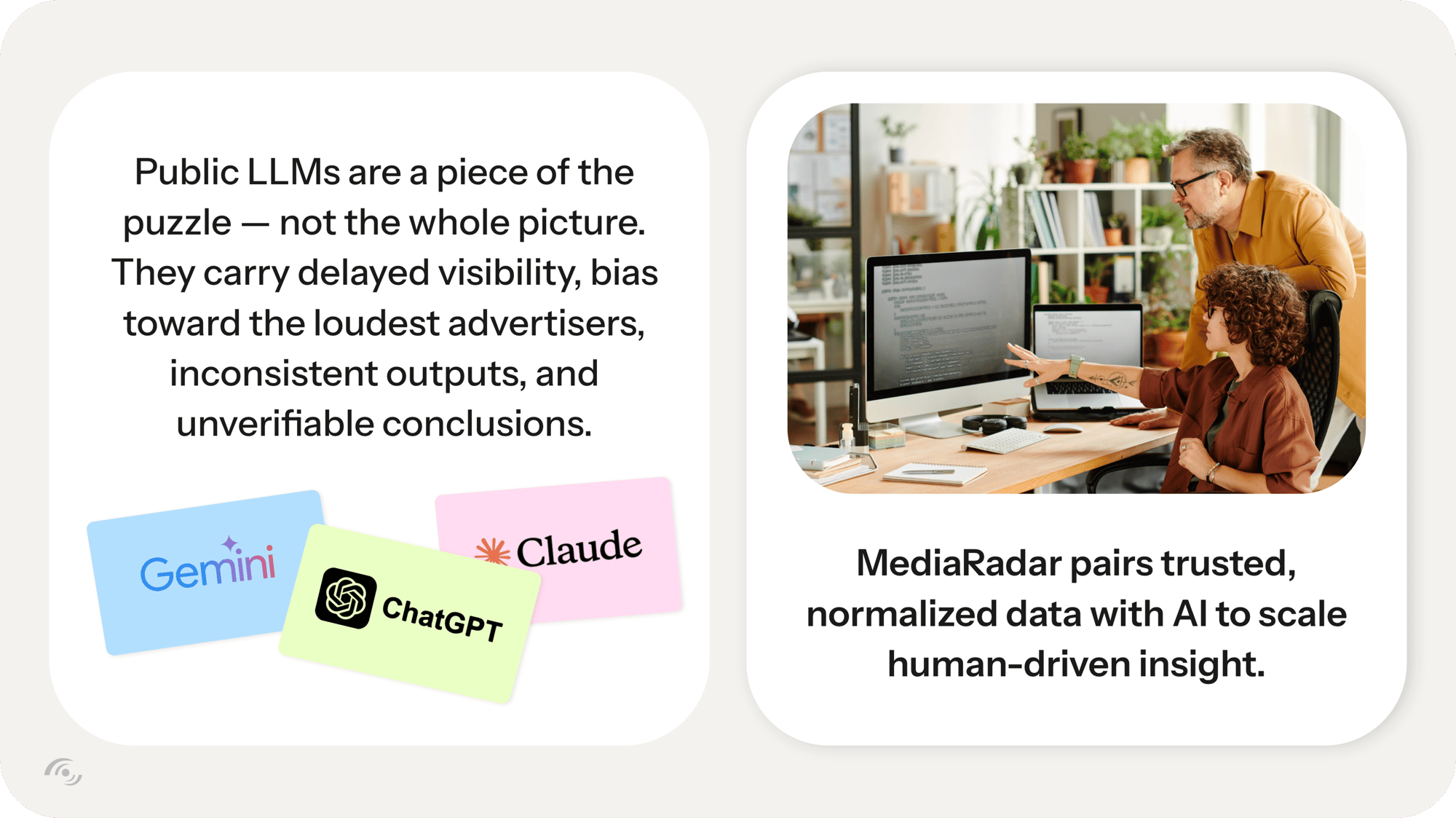
That points to the actual lever brands have: LLMs don't have a "media buy" the way search and social do. You can't pay directly to be the recommendation the way you'd pay for a sponsored slot. What you can influence is the volume, consistency, and credibility of text-based signal about your brand across the web—because that's what the model is pattern-matching against when a user asks "what should I buy."
A few things that actually move the needle:
- Third-party validation over first-party claims. Models weight independent sources (review sites, comparison articles, forums, press) more heavily than brand-owned content, because that's closer to how they're trained to detect "consensus."
- Structured, consistent facts. Specs, pricing, and positioning need to say the same thing everywhere—inconsistent claims across your own site vs. retailers vs. reviews create the same "unverifiable" problem we flagged with AI search generally.
- Depth of coverage, not just volume. A handful of detailed comparison pieces that clearly explain why your product wins a specific use case tend to outperform broad, shallow mentions—because that's the kind of content an LLM can extract a confident recommendation from.
The honest caveat: this space is still forming, and "AI SEO" or "answer engine optimization" tactics are largely unproven and changing fast—we'd point you to the AI Visibility Index and Readiness Assessment EMARKETER built as a starting benchmark rather than claim there's a settled playbook yet. This is very much the frontier, not the fundamentals.
How is MediaRadar thinking about the shift of advertiser budgets toward AI platforms like ChatGPT, Claude, and Gemini? Are you already seeing that spend show up in your data, and how are you forecasting its impact on the broader media mix?
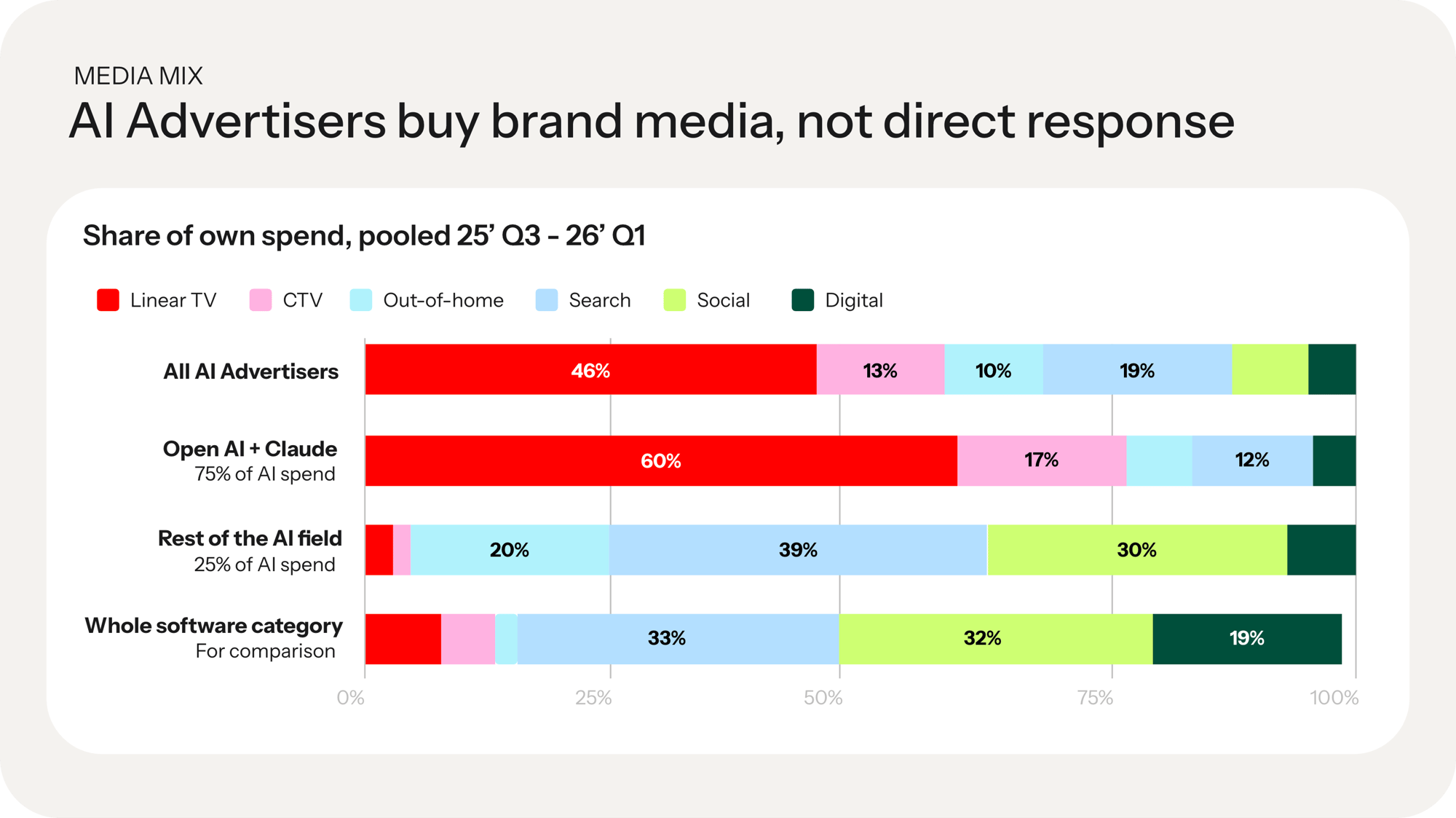
What we're already tracking: AI companies as advertisers. OpenAI and Claude alone account for 75% of tracked AI-cohort ad spend, and we're watching companies like Genspark go from zero tracked spend to a top-five AI advertiser in three quarters. And notably, these AI companies are buying brand media, not direct response—their spend mix skews toward TV, CTV, and social rather than search or digital performance channels, which tells you they're playing the long game on brand trust, not short-term acquisition.
What we're not yet seeing in the data: advertiser dollars flowing into AI platforms as ad inventory (i.e., brands paying to place ads inside ChatGPT, Gemini, or Claude conversations the way they buy search or social inventory today). That inventory model is still nascent and largely unmonetized at scale—EMARKETER’sforecast of AI ad spend hitting $32B in 2026 and $68B by 2030 is mostly measuring AI-adjacent spend (AI search, AI-enabled targeting/optimization) rather than "ads served inside a chatbot," because that inventory type barely exists yet in a trackable form.
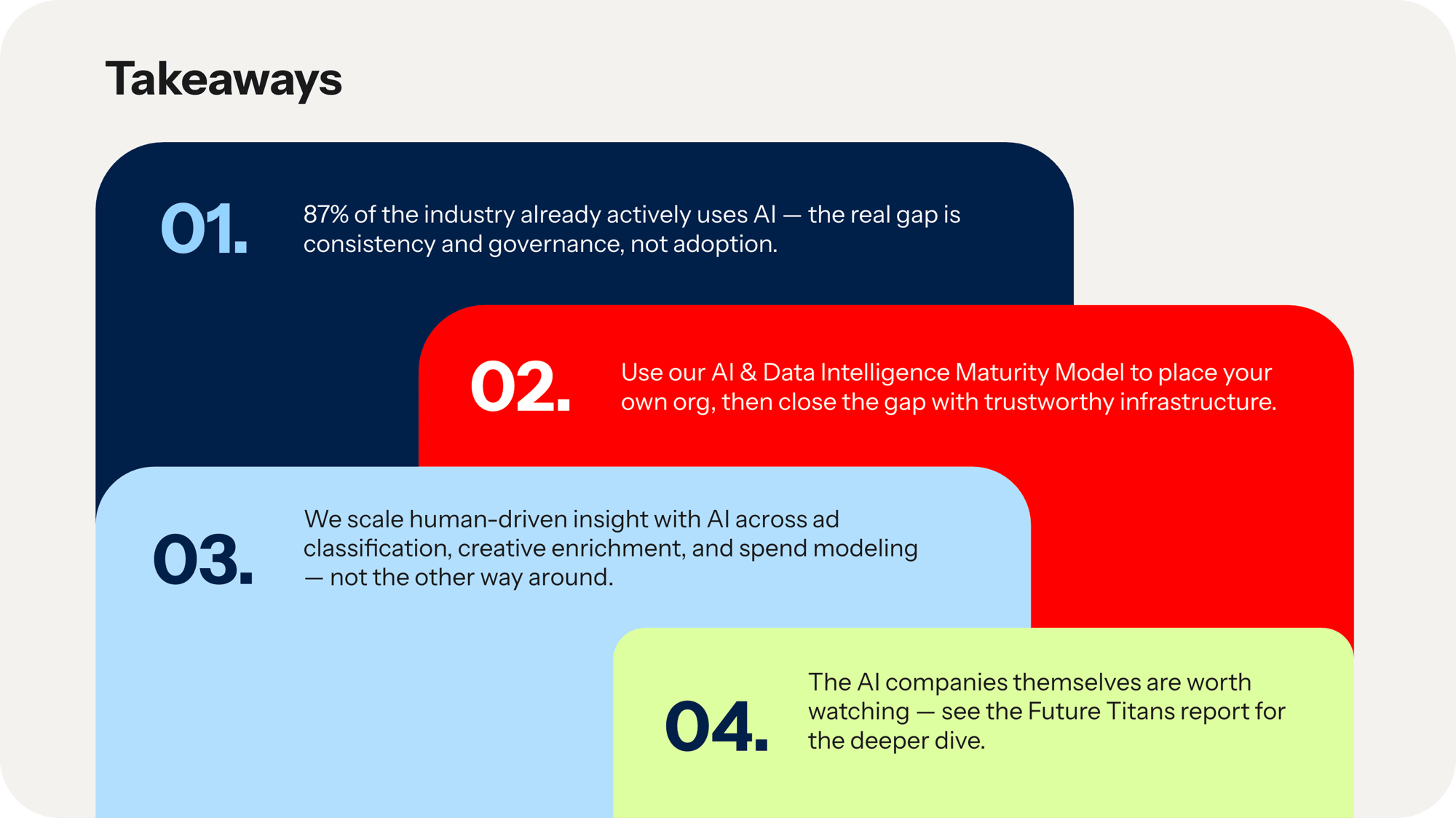
So the honest read: right now, the AI companies are the advertisers, not (yet) the ad platform. If and when OpenAI, Google, or Anthropic start selling placement within AI answers the way Google monetized search results, that's a new inventory category we'd need to build tracking for—and we'd expect the same 87% of the industry using AI, but only 18% monitoring AI mentions monthly, to be caught flat-footed the way plenty of advertisers were slow on programmatic and social. We're watching for the first signals of that shift closely, but we're not forecasting spend into a channel that doesn't functionally exist yet.
I'm interested in your survey results and analysis on how AI impacts the total addressable market for advertising. Do you see it as additive, do you think it will deprecate digital advertising in terms of effects on platforms and formats, or is it more of a hybrid, where the TAM grows overall while some platforms and formats lose share?
A few data points that shape that view:
The category itself is being adopted faster than anything before it. Search took 11 years to reach its pace-to-$30B mark, social took 14, retail media 5—AI search is on pace to hit that same mark in roughly 2 years. That's not incremental growth layered onto existing budgets; that's a genuinely new spend category forming faster than any prior one, which is additive by definition—it's new dollars entering the system, not just reallocated ones, at least initially. EMARKETERs forecasting US AI ad spend at $32B in 2026 growing to $68B by 2030, and that's largely net-new spend tied to AI-enabled targeting, optimization, and AI search—not dollars pulled directly out of existing digital line items yet.
But within that, there's already share disruption—Google's own search is the clearest example. AI Overviews and AI Mode are shifting how the largest platform on earth captures intent, and EMARKETER's read is that the "AI front door" isn't a single chatbot, it's search itself being rebuilt. That's not TAM expansion — that's incumbent formats (traditional blue-link search, and the ad inventory built around it) absorbing real structural change from within.
The AI companies' own spend behavior hints at where this nets out. They're buying brand media—TV, CTV, social—not direct response. That's a signal that even the platforms driving this disruption believe the long game is building trust and top-of-funnel presence, not cannibalizing performance budgets outright.
Our take: expect the total pie to grow as AI-driven discovery and AI-enabled optimization pull in incremental spend that didn't exist as a line item two years ago—but expect meaningful share loss within specific existing formats (especially traditional search) as AI reshapes how that spend gets captured and measured. It's not one or the other. It's growth at the category level and disruption at the format level, happening simultaneously.
How would you recommend media companies use AI if they're focused on local markets and SMBs, rather than larger national campaigns?
A few specific recommendations:
Lean into Task and Workflow Agents, not Decision or Autonomous Agents. For SMB volume, the value isn't a system making judgment calls—it's automating the repetitive stuff that eats time at scale: drafting ad copy variants, pulling performance reports, building campaigns end-to-end from a template, optimizing spend pacing. That's where AI pays for itself fastest with local/SMB clients, because the labor cost of doing this manually per-account is what kills margin at that volume.
Use AI to make local market intelligence legible, not just available. SMBs generally can't interpret a raw competitive spend report—they need it translated into "here's what your competitor down the street is doing and here's what to do about it." That's a packaging problem AI is well-suited for: taking the same classification and enrichment work we do at scale and turning it into a plain-language recommendation a business owner without a marketing team can act on immediately.
Prioritize speed and simplicity of setup over depth of customization. National advertisers can absorb a longer onboarding for a highly tailored agent. SMBs need something that works out of the box with minimal configuration—a skill library approach (pre-built, proven workflows for common local business types) beats a bespoke build every time at this scale.
Keep humans in the loop on anything touching spend, but make the loop fast. The guardrail principle still applies—external actions (launching a campaign, spending budget) need a checkpoint—but for SMBs that checkpoint needs to be a one-click approval, not a multi-stakeholder review, or the AI efficiency gain gets eaten by process friction.
Net: for local/SMB, the AI opportunity is less about sophisticated decisioning and more about collapsing the cost and time of doing marketing well at a volume where dedicated expertise isn't economical. The companies that win this segment will be the ones that make AI invisible—just faster, cheaper campaign execution—not the ones marketing "AI-powered" as the headline.
How do you think about “AI responsibly”. Not just what it can do, but what it should do?
Guardrails and context before capability. Matt was direct about this: the two things that matter most in building agents are the guardrails (what's the sandbox it operates in) and the context (does it actually understand the specific situation it's acting in). The capability question—can AI do this?—is almost always yes at this point. The responsible question is whether you've defined where it's allowed to act and given it enough context to act well there.
Human-in-the-loop scales with consequence, not with capability. Eric's framing was practical: internal actions (drafting, updating a doc, a Slack message) can run with more autonomy because the blast radius is small. External actions—spending money, launching a campaign, changing targeting—need a human checkpoint before commitment, regardless of how confident you are in the model. "Should it" gets answered by what happens if it's wrong, not by what it's capable of when it's right.
AI should scale expertise, not replace judgment. This came up directly on the classification and creative enrichment side—the frontier model is available to everyone, the differentiator is what you feed it and how you validate it. That's the core "should" principle: AI's job is to make good human judgment operate at scale, not to substitute for it. The moment you're using AI to skip the judgment entirely rather than extend it, you've crossed from "can" into territory nobody actually vetted.
Brand authenticity as a boundary, not just a preference. Matt's answer on brand voice applies more broadly: AI can get you scale, speed, and depth, but it shouldn't cost you the human authenticity that earns trust in the first place. That's as true for internal AI use (don't let an agent's output replace your actual point of view) as it is for external-facing content.
If there's a single unifying answer: responsible AI use, in the way MediaRadar's building it, means defining the sandbox before you build the capability—deciding what an agent is allowed to touch and how much human judgment stays in the loop, before you optimize for what it's technically able to do.